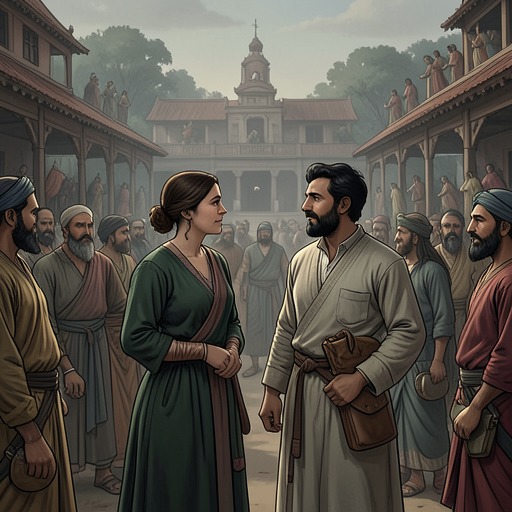
Vellya Paapen reveals Ammu and Velutha’s affair
The God of Small ThingsVellya Paapen reveals Ammu and Velutha’s affair in a rain-lashed kitchen, transforming a secret witnessed by the village into a crisis the family will try to suppress. His account is both a confession of what he has seen and an act he understands as duty; Mammachi’s response and Baby Kochamma’s intervention convert that disclosure into the machinery of expulsion and impending violence.
The Disclosure in the Kitchen
The previous afternoon, as the rain darkened the sky, Vellya Paapen arrived at the kitchen door drenched, shaking, and apparently drunk. Kochu Maria was cleaning a large fish, its scales flying across the kitchen, and initially ignored him. He waited for ten minutes before asking for Mammachi. The smell of arrack on his breath frightened Kochu Maria; suspecting the reason for his visit, she eventually called Mammachi and shut the door, leaving him in the rain outside.
When Mammachi appeared in a pale pink dressing gown, Vellya Paapen climbed the kitchen steps and offered her his mortgaged eye, saying that he did not deserve it and wanted her to take it back. The gesture refers to the debt he believes he owes the family, but also makes his own body a visible part of the disclosure. Mammachi angrily asked whether he was drunk. She then washed the eye’s fluids from her hands at the sink, while Kochu Maria gave him an old cloth. He stood sheltered at the top of the steps, almost inside the kitchen that is designated as Touchable space.
Once calmer, Vellya Paapen returned the eye to its socket and began by recalling the family’s past generosity. He said that Reverend E. John Ipe had given his father, Kelan, title to the land where the family’s hut stood, that Mammachi had paid for his eye, and that she had arranged for Velutha to receive an education and a job. Mammachi, though irritated by his drunkenness, was willing to hear stories of her family’s Christian beneficence. That familiar account of obligation prepared the ground for what she had not expected him to say.
What He Says He Witnessed
Vellya Paapen told Mammachi that he had seen the small boat crossing the river night after night and knew who was in it. He described a man and a woman standing together in moonlight, skin to skin: his son, Velutha, and her daughter, Ammu. He claimed they went to Kari Saipu’s House and interpreted their relationship through the belief that the white man’s demon had entered them. The narration presents that belief as Vellya Paapen’s explanation, not as confirmation of a supernatural cause.
He knew where the boat waited: tethered to the tree stump beside the steep path through the marsh to the abandoned rubber estate. It rocked on the water, empty until the lovers returned; sometimes they emerged from the long grass only at dawn. Vellya Paapen said he had seen them with his own eye and that others had seen them too. The lovers’ meetings were therefore secret in practice but no longer wholly private: he tells Mammachi that the whole village knows, and that it was only a matter of time before she found out.
The account makes the revelation a collision of loyalties. Vellya Paapen calls himself an old Paravan torn between loyalty and love, yet considers it his duty, as a Paravan and a man with mortgaged body parts, to tell Mammachi himself. He stresses both families’ histories and the unequal debt between them before naming the lovers as his son and her daughter. His claim that the relationship has made the unthinkable possible conveys the force of the caste and family taboo surrounding it.
Mammachi’s Rejection and Baby Kochamma’s Opportunity
As Vellya Paapen continued speaking, weeping and retching, Mammachi could no longer hear his words over the rain, which seemed to grow louder in her head. She stepped forward and pushed him down the kitchen steps. The reversal is sharply physical: the blind, elderly woman in her dressing gown touches and sends sprawling a man who, as an Untouchable, has been conditioned to expect not to be touched, particularly not in such circumstances. He landed in the wet mud, taken completely by surprise.
Baby Kochamma heard the commotion as she passed the kitchen. She found Mammachi spitting into the rain and shouting at Vellya Paapen, who lay in the slush, weeping and offering to kill Velutha—to tear his own son limb from limb. Mammachi called him a drunken dog and a drunken Paravan liar. Kochu Maria relayed his story to Baby Kochamma, who immediately recognized its potential. She represented the affair to herself as divine punishment for Ammu’s supposed sins and as revenge for her own humiliation by Velutha and the men in the march, including the taunts and forced flag-waving. Her self-righteous account turns the disclosure into a usable weapon.
Baby Kochamma put her arm around Mammachi and urged her to believe the accusation, reasoning that Ammu was capable of such conduct and Vellya Paapen would not lie about it. Her quiet reassurance stands in contrast to Mammachi’s public rage: together, however, their reactions make the story actionable. Vellya Paapen’s testimony is not examined as an account that might require protection or restraint; it becomes the basis for punishment.
The Plan and Its Consequences
The narration distinguishes the women’s roles in the response: Mammachi supplied the passion, Baby Kochamma the plan, and Kochu Maria served as their lieutenant. They tricked Ammu into her bedroom and locked her in. Before Chacko returned, they intended to send for Velutha and force him to leave Ayemenem. They could neither trust nor predict what Chacko would do, so the plan was shaped by the need to act in his absence.
The attempt to contain the affair instead sets events spinning beyond the women’s control. By the time Chacko and Margaret Kochamma returned from Cochin, it was too late to stop the consequences. The disclosure is thus a turning point not because it settles the lovers’ fate on its own, but because it exposes the relationship to a household that already has the power and motive to punish it. The rain that had brought Vellya Paapen to the kitchen is described as an omen of an end; the revelation gives that foreboding a human cause and starts the sequence that will engulf the family.